










The Right Way to Store Japanese Kitchen Knives
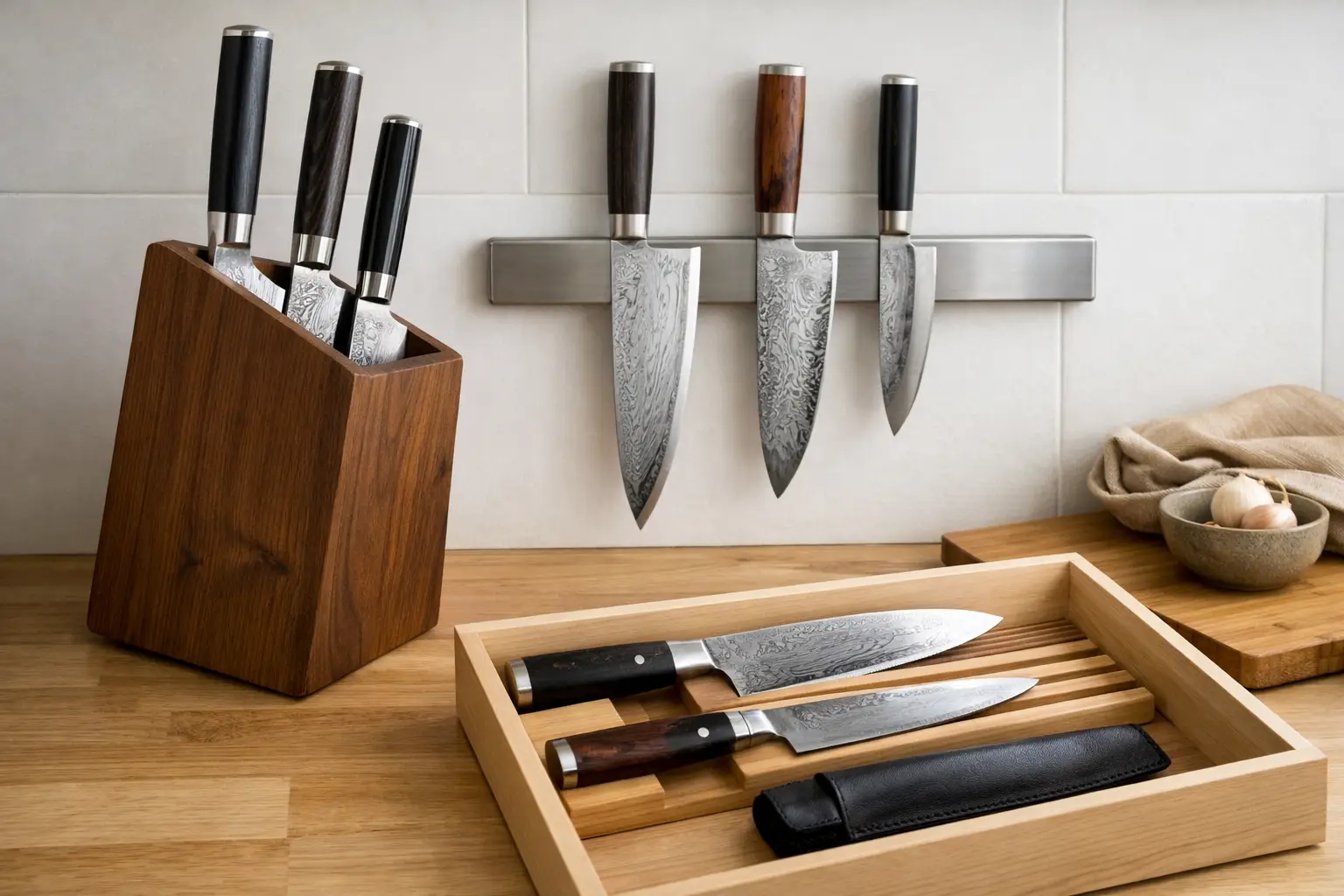
If you want a Japanese knife to stay sharp for years, how you store it matters every bit as much as how you use it. A careless drawer, a knock against metal, or a damp sheath put away too soon can quietly steal that precise feel. When you think about how to store Japanese kitchen knives, the goal is straightforward: protect the edge, control moisture, and keep the blade easy to reach without any risk.
That matters more with Japanese-style blades because they are often thinner, harder, and more finely ground than standard Western knives. That sharper geometry is part of what makes a Gyuto glide through onions or a Santoku feel so effortless on herbs and vegetables. It also means storage is not an afterthought. Good storage helps preserve performance.
Why storage matters for Japanese knives
The edge is the first thing to protect. Japanese kitchen knives are designed for clean, accurate cuts, and that performance depends on a refined edge that can be damaged by impact more easily than a thicker, softer blade. If the edge taps wood the wrong way, slides against metal utensils, or rests unprotected in a drawer, you may not notice a dramatic chip right away. More often, the knife simply stops feeling as smooth and eager in use.
Moisture is the second issue. Even stainless Japanese steels benefit from being kept dry, and carbon steel demands it. Trapped humidity can lead to spotting, corrosion, or a handle that ages poorly over time. Storage should protect the blade without creating a damp environment around it.
There’s also a safety point that gets overlooked. A sharp knife stored badly is risky for both the blade and your hands. Reaching into a drawer and catching an exposed edge is the kind of mistake you only make once.
The best ways to store Japanese kitchen knives
If you want the short answer on how to store Japanese kitchen knives, three options stand out: a magnetic wall strip, a well-designed knife block, or an edge guard inside a dedicated drawer space. The best choice depends on your kitchen, how many knives you own, and whether you prioritise display, compactness, or portability.
Magnetic knife strips
For many home cooks, a magnetic strip is the best balance of protection, convenience, and everyday ease. It keeps blades off the counter, lets them dry fully in open air, and prevents edge-to-edge contact.
The important detail is the surface. A quality strip with wood facing is gentler than exposed metal. It holds the knife securely without slamming the blade against a hard surface. When placing the knife, spine first and edge away from the strip is the safer habit. That small movement helps avoid chipping the cutting edge.
This setup works especially well if you use your knives often and want them within easy reach. It also suits lighter Japanese profiles beautifully. The trade-off is visibility. If you prefer a clutter-free look or have very limited wall space, a strip may not fit your kitchen.
Knife blocks
A knife block can work very well, but not every block is equally good for Japanese blades. Traditional slotted blocks are convenient, though some slots are sized around thicker Western knives and may fit a slim Japanese blade awkwardly. If a knife rattles, rubs, or needs to be forced into place, the block is not doing the blade any favours.
Universal blocks with flexible rods or carefully sized slots can be a better fit. The key is that the knife goes in cleanly without scraping the edge. Orientation matters too. Many people store knives edge-down, which gradually wears the edge against the block’s interior. Spine-down is usually the safer choice if the design allows it.
Blocks are a strong option if you want countertop storage without mounting anything to the wall. They also keep knives tucked away from children more effectively than an open strip, depending on placement.
Drawer storage with edge guards
A drawer can be a perfectly good home for Japanese knives if the blade is protected properly. The problem is not the drawer itself. The problem is loose storage.
If knives slide around beside peelers, serving spoons, and random kitchen tools, the edge will suffer quickly. A fitted edge guard or saya, combined with a drawer insert that keeps each knife in place, solves most of that risk. This is also one of the best options if you want your counters clear.
For smaller kitchens, it’s often the most practical choice. Just make sure the drawer stays dry and the knife is fully clean before it goes back in.
How to store Japanese kitchen knives safely
Whatever storage method you choose, the rules stay the same. The blade should be clean, completely dry, and protected from contact with hard objects. That sounds obvious, but most knife damage happens in ordinary moments - after washing up quickly, after dinner cleanup, or when a knife gets set down “just for now” and never makes it back to its proper place.
A few habits make a real difference. Don’t store a knife while there’s still moisture near the heel, handle junction, or inside a sheath. Don’t stack knives together, even briefly. And don’t leave a blade on a dish rack where it can tip, knock into ceramic, or be grabbed carelessly.
If your knife has a wooden handle, especially wa-style, dry it thoroughly and avoid any storage spot that stays humid. Closed containers or covers can be fine, but only when the knife is fully dry first.
What about a saya?
A saya, or wooden blade sheath, is one of the most elegant ways to store and transport a Japanese knife. It protects the edge, shields the blade from contact, and gives a premium knife the kind of care it deserves.
It’s an especially smart choice if you keep knives in a drawer, take them to cooking classes, or simply want extra protection between uses. But a saya is not magic. If you slide in a damp knife and leave it there, you can create exactly the kind of moisture problem you were trying to avoid.
Used correctly, though, it’s an excellent solution. Many serious home cooks find that a magnetic strip for daily access and a saya for travel or long-term storage covers everything they need.
Storage mistakes that shorten a knife’s life
The worst mistake is tossing a Japanese knife into a drawer unprotected. It’s hard on the edge, unsafe for your hands, and almost guaranteed to dull the blade faster than necessary.
The second mistake is storing it wet. Stainless steel is not stain-proof, and carbon steel is less forgiving still. Water spots, micro-rust, and handle wear all start with moisture left behind.
Another common issue is using the wrong storage for the knife you own. A heavy cleaver and a slim Bunka do not behave the same way. A compact petty knife might sit safely in a drawer insert, while a longer Gyuto may be better on a magnetic strip where the blade is not squeezed into a tight slot.
It also depends on your kitchen rhythm. If you cook every day, the best storage is often the one that makes proper care easiest to repeat. Convenience matters because the perfect system only works if you actually use it.
Choosing the right storage for your kitchen
If you own one or two premium knives and use them constantly, a wood-faced magnetic strip is hard to beat. It protects the edge, looks clean, and turns a great knife into part of your everyday setup rather than something hidden away.
If you have a full set, limited wall space, or prefer a tidier look, a quality block or organised drawer system may suit you better. The main question is whether each blade has its own secure place and stays dry.
For gift buyers or newer owners, this is worth remembering: storage is part of knife care, not an accessory afterthought. A beautifully balanced blade deserves a home that preserves what makes it special. That is especially true once you upgrade into Japanese steel performance. The edge you paid for should still be there months later, not worn away by bad habits.
At Shimeru, we think good knife care should feel simple, not intimidating. Store the blade somewhere dry, stable, and protected from impact, and you’ve already done one of the most important things for long-term performance.
A great Japanese knife rewards small, consistent care. Give it a proper place in your kitchen, and every prep session feels a little more precise, a little smoother, and a lot more satisfying.